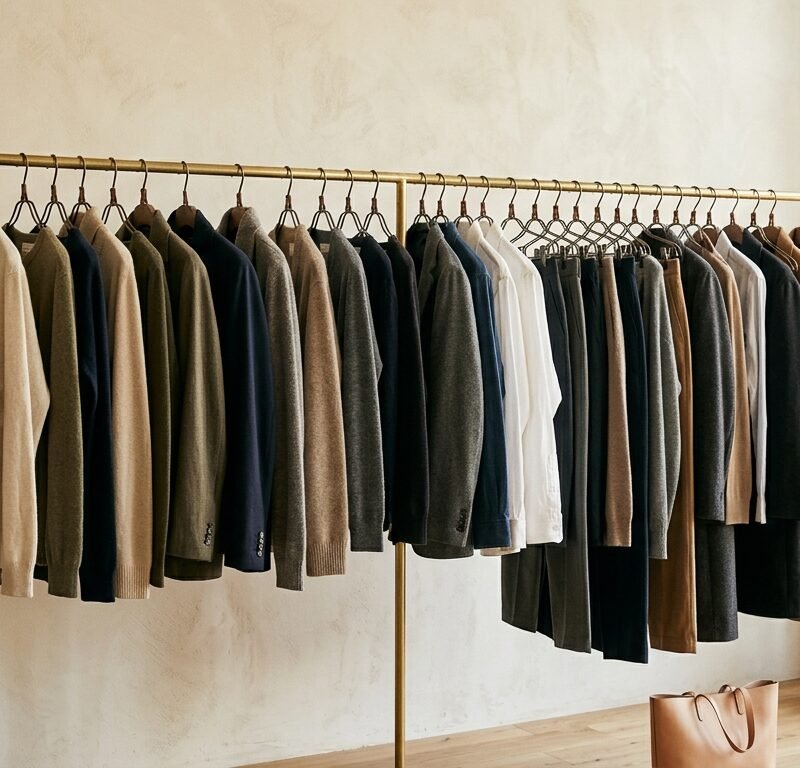
The capsule wardrobe has been ruined by its own evangelists. It has become a lifestyle rather than a method, and the number is always suspiciously round. This is not that. This is the arithmetic.
The combination maths
Suppose you own six tops and four bottoms that all genuinely work together. That is 24 outfits. Add one more top and you have 28. Add a layer that works over all six tops and you are at 48. The growth is multiplicative, and it comes almost entirely from compatibility rather than count.
Now suppose two of the six tops only work with one of the bottoms. You have not lost two outfits, you have lost eight. This is why a wardrobe of forty things can feel emptier than a wardrobe of twenty: the incompatible pieces are not neutral, they are actively subtracting.
Where the number lands
In practice, for most people in most Indian cities, the number is around thirty pieces excluding underwear, socks and outerwear. That is roughly:
- Eight to ten tops across shirting and jersey, in no more than four colours.
- Four to five bottoms, two of which should be genuinely neutral.
- Three layers: one light, one warm, one that handles rain.
- Three pairs of shoes, one of which you can walk five kilometres in.
- The rest is specific: the thing you wear to weddings, the thing you travel in, the thing you have had for nine years and will not part with.
The rule that does the work
Before buying anything, name six things you already own that it goes with. Not three, six. If you cannot get to six, the piece is a specialist, and specialists are fine as long as you know you are buying one and price it accordingly.
This is the same test we apply internally before a piece goes into sampling, and it is the reason our range is smaller than it could be.
What this is not
It is not an argument for owning less as a virtue, and it is certainly not an argument for replacing a working wardrobe with a new one, which would be absurd coming from a shop. It is an argument for a particular kind of addition: the piece that multiplies rather than the piece that sits.
The outfits are our attempt to do the arithmetic for you. Each one is four or five pieces chosen so that every item works with every other, which is why the same overshirt turns up in three different looks.